
What’s the difference between the Interstate Highway System and U.S. Highways?
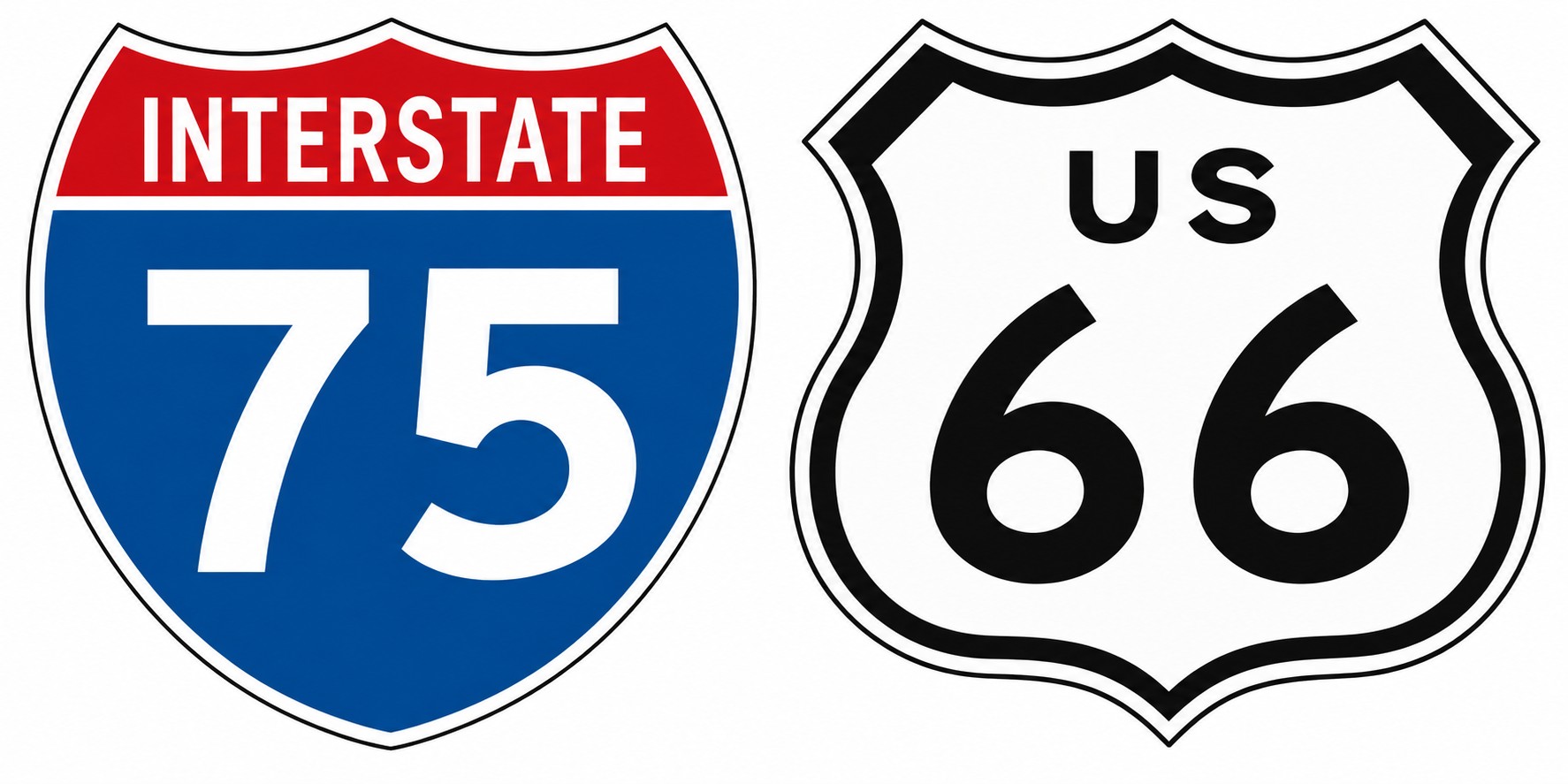
What’s the difference between the Interstate Highway System and U.S. Highways?
You may have been riding on highways for many years without thinking about how the signs change slightly depending on what type of road you are on. If you are taking a long road trip, your travel times could vary drastically depending on which route you choose, so it is good to know your options.
Are you on the Interstate?
Although many roads are called highways, not all of those roads are part of the Interstate Highway System. A big clue is the route marker. Interstate Highways use the familiar red, white, and blue shield. Some Interstate shields include the word “INTERSTATE” at the top, while others display just the route number within the distinctive red, white, and blue design.
The Interstate Highway System is one of the largest and most important road networks in the world. It includes more than 49,000 miles of highways connecting major cities, states, and regions across the United States. The modern Interstate System took off in 1956, when Congress passed the Federal-Aid Highway Act of 1956, providing funding for construction on an unprecedented scale. The system was designed to help people travel more efficiently, improve safety, support military transportation during national emergencies, and move goods across the country.
What is the difference between an Interstate Highway and a U.S. Highway such as U.S. Route 66?
In addition to the Interstate Highway System, there are other highways that cross multiple states. The U.S Highway System began in 1926, so it predates the Interstate Highway System (1956) by about 30 years. Both are nationwide networks of numbered roads, but they serve slightly different purposes.
Here are some of the key differences:
Access: U.S. Highways can range from ordinary two-lane roads with driveways and intersections to major multilane freeways. A U.S. Highway may have traffic lights, intersections, and even driveways entering onto the highway, whereas Interstate Highways have limited access using entrance and exit ramps instead of intersections.
Purpose: U.S. Highways connect many cities and towns that are not served by Interstate Highways. Interstate Highways are designed for high-speed, long-distance travel.
Sign color: U.S. Highways are identified by a black-and-white shield, while Interstate Highways use a red, white, and blue shield.
Numbering: On Interstate Highways the main east-west routes generally have even numbers increasing south to north; north-south routes have odd numbers increasing west to east. U.S. Highways generally follow a reverse pattern, with even routes increasing north to south and odd routes increasing east to west.
Interesting facts
Alaska, Hawaii, and Puerto Rico all have Interstate Highways, even though they aren't connected to the Interstate Highway System in the continental United States.
There is currently no Interstate 50 or Interstate 60. When Interstate numbers were originally assigned, planners avoided giving an Interstate the same number as a U.S. Highway in the same state, helping prevent confusion between the two systems.
Although Interstate 90 is the longest Interstate Highway (about 3,020 miles), U.S. Route 20 is even longer. It stretches for about 3,300 miles, from Newport, Oregon to Boston, Massachusetts. Route 20 travels through 12 states. That means that if you started with your feet in the Pacific Ocean at Newport, Oregon, and kept following U.S. 20, you'd eventually reach Boston—without ever changing highway numbers. And then, of course, you should dip your toes in the Atlantic Ocean.
At NHSA, our goal is to provide online driver education courses that equip all drivers with what they need to be safe drivers. Whether you are a teen seeking a learner’s permit, or an adult driver seeking a basic driver safety course, check us out online to see what courses are available in your state!