CDL Direct Blog
Blog posts of '2026' 'August'
Big Rigs - Nighttime Driving
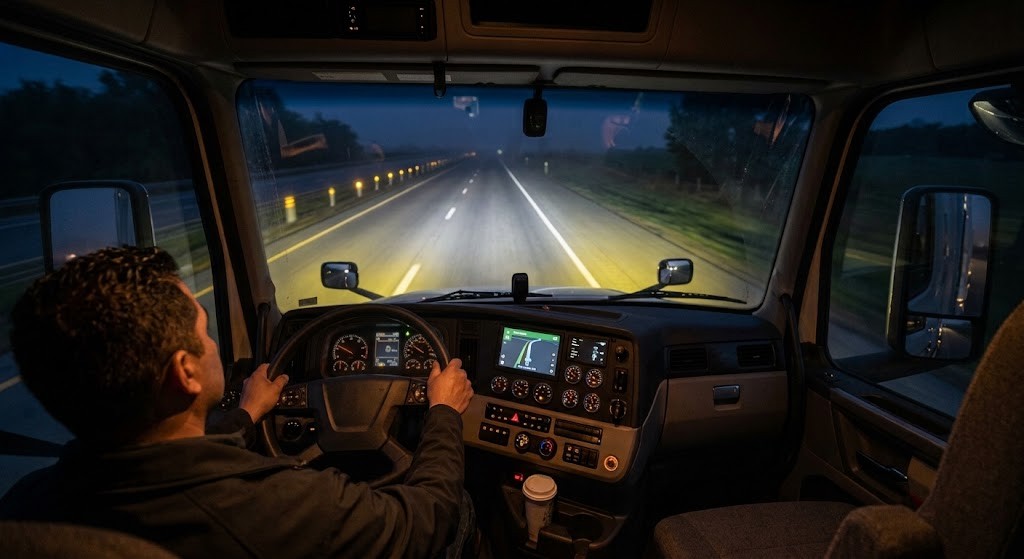
There are both rewards and challenges for nighttime driving as a CDL driver. You may prefer driving when the roads are less crowded, you may get higher pay, experience faster turnaround times, and have zero-delays. While these rewards are very attractive, they aren’t the only consideration for nighttime driving.
Challenges include reduced visibility, greater fatigue risks, glare, and more difficulty spotting hazards. For CDL drivers, learning how to safely operate a big rig after dark is an essential professional skill. The following preparation and habits can help make nighttime driving safer, so you can enjoy the rewards without falling victim to the pitfalls.
1. Start With Your Lights
Federal regulations require commercial motor vehicles to have specific lamps and reflective devices, and drivers cannot operate a CMV when required lamps or reflective material are obscured by dirt, cargo, or other equipment. Make it a habit to check your headlights, taillights, brake lights, turn signals, clearance lights, and reflective devices, before heading out. When cleaning your headlights, mirrors, windshield, and camera lenses, keep in mind, dirt, bugs, and streaks can make nighttime glare worse and reduce visibility.
Pro tip: Keep dashboard lights dimmed to maximize outer night-vision responsiveness.
2. Slow Down for What You Can See
At night, you simply cannot see as far ahead as you can during the day. Your speed should allow you enough time and distance to recognize a hazard and react safely. FMCSA reminds drivers that large trucks have long stopping distances and that drivers should operate at a safe speed for the road, weather, and traffic conditions and not just at the posted speed limit.
Pro tip: Standard low-beam headlights project roughly 250 feet. At 65 mph, a fully loaded 80,000 lb tractor-trailer requires over 500 feet to stop. Therefore, keep extra space around your trailer and never outrun your headlights.
3. Stay Alert to Fatigue
Night driving can work against your body's natural sleep cycle. FMCSA identifies the period between midnight and 6 a.m. as a time when many people are naturally more drowsy and less alert. Know the warning signs, including frequent yawning, heavy eyes, blurred vision, wandering thoughts, or difficulty staying focused. If you become too tired to drive safely, find a safe place to stop and rest. Some may try turning up the radio or opening a window to stay awake, but these cannot substitute for sleep.
Pro tip: Maintain strict daylight sleeping habits with blackout curtains and consistent sleep hygiene.
4. Know Your Hours of Service
Night driving does not change the federal Hours-of-Service limits. For most property-carrying CDL drivers, HOS rules limit driving time and require qualifying off-duty periods and breaks. Your ELD records your driving and duty time, but you are still responsible for planning your trip and staying within the applicable limits. While these rules may seem to hold you back, they are designed help drivers get the rest needed to remain alert and keep you and others safe.
Pro tip: Plan ahead for fuel, rest breaks, and safe parking. Don't wait until you're almost out of available hours to start looking for a place to stop.
5. Watch for Nighttime Hazards
After dark, hazards can appear with less warning. Watch carefully for pedestrians, cyclists, wildlife, disabled vehicles, work zones, and drivers who may be impaired or fatigued. FMCSA recommends regularly checking mirrors and looking ahead for developing traffic problems, work zones, and other hazards. Make sure to give yourself extra following distance so you have more time to react.
Pro tip: Many newer trucks have thermal night-vision sensors to give night drivers maximum situational awareness.
6. Keep Distractions Out of the Cab
Nighttime requires even more concentration. Set your GPS and route before moving, put away your phone, and avoid activities that take your attention away from driving. Federal regulations prohibit commercial drivers from texting while driving and restrict the use of handheld mobile phones.
Pro tip: If something needs your attention, pull over safely before dealing with it.
At CDL Direct, we don’t just prepare you to pass the exam. Our course is designed to prepare you for real-world situations—inspections, roadside stops, crashes, and the decisions and driving techniques that protect your livelihood.

The Pros and Cons of Driving a School Bus
Some people pursue a CDL due to specific scheduling needs. Perhaps you're a parent who needs to be home with your children at certain times, a student pursuing higher education who needs time for classes and studying, or someone with other responsibilities that require a flexible schedule.
School bus driving can be a surprisingly good fit for people who want professional driving experience while maintaining a more predictable schedule and avoiding weeks at a time on the road. However, it isn't for everyone. Before deciding to become a school bus driver, take a realistic look at both the rewards and the challenges.
The Pros: A CDL Career With a Different Lifestyle
You can often be home every day. School bus routes are usually local and follow the school calendar. Many positions offer morning and afternoon routes, making them attractive to parents, retirees, students, and people looking for part-time work.
Training may be paid. Many school districts and private transportation companies recruit people with no previous bus-driving experience and provide or pay for CDL training. Some employers also offer health insurance, retirement benefits, paid time off, referral bonuses, or opportunities to earn additional money through field trips, athletic events, substitute routes, or summer work.
Sign-on bonuses can be substantial. Incentives vary widely by employer and location. A recent example includes $2,500–$5,000 sign-on bonuses for eligible school bus drivers. Other employers may offer paid training instead or additional retention incentives. Always check the conditions, as bonuses may require completion of training, specific endorsements, or staying employed for a certain period.
You make a difference. You're responsible for getting children to and from school safely every day. For drivers who enjoy working with young people and becoming part of their community, that can be one of the most rewarding parts of the job.
The Cons: It's More Than Just Driving
Student behavior can be the biggest challenge. Kids may get loud, argue, stand while the bus is moving, bully others, get into fights, or even disrespect you. The driver still has to maintain control of the vehicle and keep their attention on the road.
Experienced drivers frequently recommend establishing expectations early, learning students' names, using consistent rules, assigning seats when appropriate, and working with school administrators when behavior becomes a safety issue. One important safety principle should never change: If student behavior becomes unsafe, the driver should prioritize controlling the bus and getting everyone safely stopped rather than trying to manage the situation while driving. Experienced drivers report that consistency and clear boundaries can make difficult routes much more manageable.
The schedule can be split. A typical route may involve an early-morning run followed by several hours before the afternoon route. That can be a benefit if you want flexibility and a part-time schedule, but can also be a disadvantage if you need a traditional full-time, continuous workday.
You are taking on a serious responsibility. A school bus can carry dozens of children, and they and their families are relying on you to get them home safely. You must constantly watch traffic, mirrors, railroad crossings, students entering and exiting the bus, and changing road conditions. Patience and defensive driving aren't optional.
Is School Bus Driving Right for You?
School bus driving may not be the right choice if you become easily distracted by noise, dislike working with children, have difficulty enforcing boundaries, or want long-distance driving and extended time on the road.
However, it could be a great fit if you don't mind a split schedule during the day, are patient and comfortable working with children, can stay calm when things get noisy or unpredictable, and take safety rules seriously. If that sounds like a responsibility you're ready to take on, earning your CDL and the required endorsements can open the door to a career that's local, meaningful, and in demand.
At CDL Direct, we don’t just prepare you to pass the exam. Our course is designed to prepare you for real-world situations—inspections, roadside stops, crashes, and the decisions and driving techniques that protect your livelihood.

5 Steps to Prepare for an OTR Trip
Before you jump in your truck for a long over-the-road (OTR) trip, you might prepare emotionally and mentally by saying your goodbyes to your family. Perhaps you give a round of hugs and reassure them that you will be back before they know it. You promise to call every day.
In addition to getting yourself in the right mindset, there are some steps you can take to prepare. These can mean the difference between a smooth run and hours lost to breakdowns, bad weather, traffic, parking problems, or an avoidable HOS violation. Here are some of the steps experienced drivers use to get ready.
1. Know Your Route Before You Roll
Don't simply enter the destination into your GPS and go. Review the entire trip, including major cities, construction zones, mountain grades, toll roads, truck restrictions, fuel stops, and parking areas before you encounter or need them. There are specialized commercial vehicle GPS apps that you can use to plan your route. This can help you avoid passenger-car navigation apps that may send a CMV onto roads with low bridges, weight restrictions, or other limitations. Many OTR drivers also find it helpful to have a primary route and a backup route to save time if they are faced with last-minute changes.
Professional tip: Carry what your company permits and what you realistically may need on the road such as appropriate clothing for changing weather, food and water, phone chargers, basic personal supplies, and any company-required emergency equipment.
2. Check the Weather Along Your Route
Weather can change dramatically during a multi-state trip. Check conditions along the entire route, especially when traveling through mountain passes, areas prone to snow and ice, severe thunderstorms, flooding, high winds, or extreme heat. Under the FMCSA's "adverse driving conditions exception", qualifying unforeseen adverse conditions can extend the driver's normal driving window by up to two hours. However, this does not automatically give a driver two additional driving hours simply because a trip is running late. The conditions generally must have been unforeseen when the trip began.
Professional tip: Don't use an HOS exception as a trip-planning strategy. If conditions become dangerous, slow down, find a safe location, and communicate with your carrier.
3. Know the Rules of the Road Across State Lines
When driving OTR, you'll cross through multiple states, and some rules can vary by state. Crossing a state line doesn't mean the federal rules disappear but you may have additional state and local requirements to follow. Before your trip, check for state-specific requirements such as speed limits, truck routes, weight restrictions, chain requirements, and road closures. When in doubt, follow the posted restriction and ask your carrier for guidance.
Professional tip: Your carrier, dispatcher, state transportation agency, truck-specific GPS, and official state resources can all be useful to check for current truck restrictions and road conditions before entering a new state.
4. Inspect the Truck and Trailer
A good OTR driver doesn't treat the pre-trip inspection as a formality. Many experienced drivers recommend making sure to "look close" during a thorough walk-around. Make sure to check the tires, wheels, brakes, lights, mirrors, windshield, wipers, coupling equipment, hoses, belts, fluids, emergency equipment, and other required components. FMCSA regulations require drivers to be satisfied that the vehicle and equipment are in good working order before operating it. If you have a specialized load, make sure your cargo is secured according to the applicable requirements.
A written report is not generally required specifically for the pre-trip inspection under §392.7, but defects discovered during operations must be handled according to the applicable inspection and reporting requirements.
5. Know Your Hours of Service (HOS)
Before you start your trip, know how many hours you can legally drive and when you need to take breaks and rest. Plan your trip around your available driving hours and not just the number of miles you'll be driving. Remember to leave enough time for traffic, weather, loading delays, fuel stops, and finding a safe place to park. For most property-carrying drivers, federal HOS rules include an 11-hour driving limit within a 14-hour work window, a 30-minute break after 8 cumulative hours of driving, and at least 10 consecutive hours off duty before starting a new driving period.
Most drivers required to maintain records of duty status must use an FMCSA-registered ELD. Drivers should know how to operate their device, review their logs, make appropriate annotations, and handle an ELD malfunction.
At CDL Direct, we don’t just prepare you to pass the exam. Our course is designed to prepare you for real-world situations—inspections, roadside stops, accidents, and the decisions and driving techniques that protect your livelihood.

Owner-Operator: Steps to Getting Your Business Off the Ground
Perhaps you are just starting out, or maybe you’ve been driving trucks for a while and now want to invest in starting your own business where you are the boss. As an owner-operator, you decide which loads to haul, who you work with, and how you grow your business. This can be one of the most rewarding careers in trucking, but it requires planning, discipline, and a commitment to safety. These key attributes can make the difference between simply owning a truck and building a profitable trucking business. The most profitable owner-operators are business owners first and drivers second. If you're thinking about making the leap, here's a practical roadmap to help you get started.
1. Start With a Strong Foundation
Before investing thousands of dollars in equipment, build your driving experience. Many successful owner-operators recommend spending at least one to three years driving for an established carrier. During that time, pay attention to freight lanes, fuel costs, maintenance expenses, customer service, and how dispatch works. Consider this as part of your training and preperation for owning your own company later on. Experienced drivers often say, "Learn the business while someone else is paying for your mistakes."
Freight markets, technology, FMCSA regulations, insurance costs, and customer expectations continue to evolve. The most successful owner-operators stay current through continuing education, safety training, industry publications, and networking with other professionals.
2. Create a Business Plan
Many new owner-operators underestimate how much cash they need during the first several months. Successful drivers recommend having enough savings to cover several months of operating expenses in case freight slows down or you face unexpected repair costs. When drafting your plan, make sure it includes startup costs to cover monthly operating expenses, insurance premiums, a fuel budget, costs for maintenance and repairs, taxes, and some emergency savings. Then compare all that to your expected revenue.
Also try to have a plan of who you will market to and work for so your work stays relaible. A key to making this process successful is networking with freight brokers, direct shippers, dispatch services, repair shops, tire dealers, fuel discount programs, and factoring companies (if needed). An added benefit is that networking with other experienced drivers can also provide valuable advice on freight markets, maintenance, and avoiding costly mistakes
Many owner-operators operate as an LLC or corporation, although the best choice depends on your individual financial and tax situation. Before filing paperwork, consider speaking with a qualified accountant or business attorney who understands the trucking industry.
3. Obtain Your Operating Authority
Before you can haul freight under your own authority, you'll generally need to:
- Obtain a USDOT Number
- Obtain FMCSA Operating Authority (MC Number), if required
- File proof of insurance
- Designate a process agent (BOC-3 filing)
- Register for Unified Carrier Registration (UCR), when applicable
- Meet state registration requirements such as IRP and IFTA if operating across state lines
New interstate motor carriers also enter FMCSA's New Entrant Safety Assurance Program, which includes a safety audit during the first 12 months of operation. Good recordkeeping from day one makes this process much easier.
4. Understand Your FMCSA Responsibilities
If you operate under your own authority and employ yourself as the CDL driver, you have responsibilities as both the employer and the driver.That means you're responsible for complying with Federal Motor Carrier Safety Regulations (FMCSRs). One area that surprises many new owner-operators is the FMCSA Drug and Alcohol Clearinghouse. FMCSA requires owner-operators to designate a Consortium/Third-Party Administrator (C/TPA) to perform required Clearinghouse functions and drug and alcohol program responsibilities. Besides the Drug and Alcohol Clearinghouse, you will also have to comply with Hours-of-Service regulations, ELD requirements, Driver Qualification Files, all vehicle records, annual inspections, cargo securement regulations, and accident register requirements.
5. Buy the Best Truck For Your Business
Veteran owner-operators consistently recommend purchasing a truck that fits your business model rather than buying the newest or most expensive model available. It is always a good rule of thumb when purchasing a commercial motor vehicle (CMV) to consider fuel economy, maintenance history, parts availability, warranty coverage, payload capacity, reliability, and resale value. A truck that's paid off often generates more profit than an expensive truck with large monthly payments.
6. Stay on Top of the Math
Gross income doesn't equal profit. So while your total income may seem a lot on paper at first, make sure you also track key business metrics like cost per mile, fuel cost per mile, deadhead percentage, maintenance cost, gross revenue, and then net profit. Many experienced owner-operators review these numbers regularly to see how they are managing, rather then just at tax time. This can make a difference in the decisions you make as a company owner and driver.
At CDL Direct, we don’t just prepare you to pass the exam. Our course is designed to prepare you for real-world situations—inspections, roadside stops, accidents, and the decisions and driving techniques that protect your livelihood.